Course Overview


Playwright Course
What You'll Learn & Build
Industry skills that take you from zero to automation expert
 Playwright


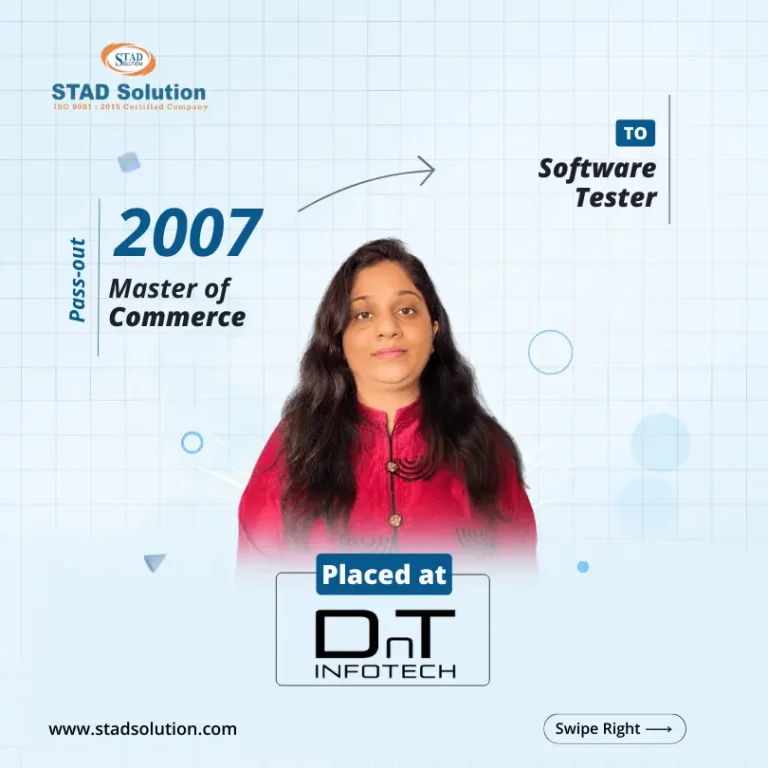


Best Training
STAD Solution transformed my IT skills. Excellent trainers, practical approach, and great learning atmosphere. Highly recommended

Mayank Verma
Placed In - TechMahindra Lodestone
Hands-On Training
Enrolling at STAD Solution was a game-changer. Top-notch courses, industry-relevant content, and dedicated instructors.

Arpi Patel
Placed In - TechMahindra Lodestone
Qualified Faculties
STAD Solution exceeded my expectations. Cutting-edge curriculum, hands-on labs, and supportive staff.

Tarshul Mehta
Placed In - Mplify
Practical Training
Choosing STAD Solution was the best decision. Exceptional training programs, expert guidance, and real-world projects.

Dhruvi Parikh
Placed In - Spyker Ltd
Personalized Attention
STAD Solution equips students for the IT industry with innovative courses, latest technologies, and personalized attention.

Aman Gohil
Placed In - codExalters Techlabs
Quality Training
Quality training, expert instructors, updated content, and practical exercises. Remarkable for IT enthusiasts

Dipesh Chauhan
Placed In - Ellkay Software


Certificates


Curriculum
Introduction of JavaScript
Setting up Node.js and VS Code
Variables (var, let, const)
Data Types (string, number, boolean, array, object)
Operators & Expressions
Functions (normal, arrow functions)
If-else, Switch
Loops: for, while, for-of, forEach
Scope & Closures
Objects & Arrays
Array Methods (map, filter, reduce)
JSON Basics (parsing & stringifying)
Error Handling with try/catch
ES6+ Features (Template literals, Destructuring, Spread/Rest)
Modules: import and export
npm Commands
Node.js File System Basics
Introduction to Playwright & Features
Installation and Setup
First Playwright Script
Writing Tests with Playwright Test Runner
Hooks: beforeAll, beforeEach, afterEach, afterAll
Config File (playwright.config.js)
Playwright Locators (getByRole, getByText, getByPlaceholder)
Click, Fill, Hover, Drag-Drop
Handling Dropdowns, Checkboxes, Radio Buttons
Handling Multiple Tabs and Pop-ups
Auto-waiting & Assertions with expect()
Screenshots & Video Recording
Introduction to API Testing
Using Requests for API Calls
Validating JSON Response
GET, POST, PUT, DELETE Methods
Combining API + UI Tests
Why is POM Needed
Creating Page Classes in JavaScript
Structuring Large Projects
Reusability & Maintainability
End-to-End Framework Setup
What is Maven & Why Use It
Maven Project Structure (pom.xml)
Adding Dependencies in pom.xml
Running Tests via Maven
Maven Lifecycle: compile, test, package
Maven Surefire Plugin
What is Git & Version Control
Git Installation & Configuration
git init, add, commit, status, log
Branching: create, switch, merge
Creating GitHub Repository
git push, pull, clone, fetch
Pull Requests & Code Review
Resolving Merge Conflicts
.gitignore Setup for Node.js
What is CI/CD
Jenkins Installation & Setup
Jenkins Dashboard Overview
Creating Freestyle & Pipeline Jobs
Build Triggers (manual, scheduled, webhook)
Jenkinsfile (Declarative Pipeline)
Running Playwright Tests in Jenkins
Publishing HTML/Allure Reports in Jenkins
Jenkins + GitHub Integration
Full Pipeline: Push Code → Build → Test → Report
What is Generative AI
Role of GenAI in Software Testing
Overview: ChatGPT, GitHub Copilot, Gemini
Prompt Engineering for QA
Generating Playwright Test Scripts using AI
Auto-generating Locators & Test Data
AI-assisted Debugging of Failed Tests
Using AI for Test Documentation
Practical GenAI + Playwright Workflow
FAQs
Yes. Our trainers explain everything from the basics, so this is a solid Playwright course for beginners in Pune or any other city.
The course usually takes 6 to 7 weeks, depending on your batch. It includes live sessions, assignments, and project work.
Yes. We include real project tasks like login flows, dashboard testing, and API validations that simulate how testing is done in live apps.
Recordings are shared after every session. But we still recommend attending live, as that's where problem-solving happens in real time.
It’s fully online, with live sessions, personal doubt clearing, and project support — ideal if you're looking for a practical course, not just theory.
This is a structured program. Trainers guide you live, solve your blockers, and help you move from basic to advanced topics step by step.
Yes, we cover API testing using Playwright. You'll learn how to test REST endpoints using built-in APIRequestContext in real use cases.
Yes. Many of our learners are from manual testing. We start from scratch and gradually move toward framework and advanced topics.
We teach just enough JavaScript and TypeScript for testing. You don’t need prior programming knowledge to start or complete the course.
Yes. Our Playwright Automation Course with Placement includes resume feedback, mock interviews, and help with job applications after project completion.
Yes. Once you complete project work and assignments, we issue an internship experience letter to support your resume and job applications.
No. While many students join us for Playwright automation training in Pune, the course is 100% online and open to learners across India.
Yes. We prepare you for real-world interviews with Q&A sessions, resume feedback, and topic-specific tips based on the latest trends.
In the Playwright framework course, you will build a reusable framework using Page Object Model, environment configs, and utilities — similar to what companies use.
Yes. Playwright offers faster execution and better modern web support. Many Selenium testers take this course to upgrade their automation skills.
Just fill out the enquiry form on our site or call our team. You’ll get batch details, demo info, and enrollment steps quickly.